


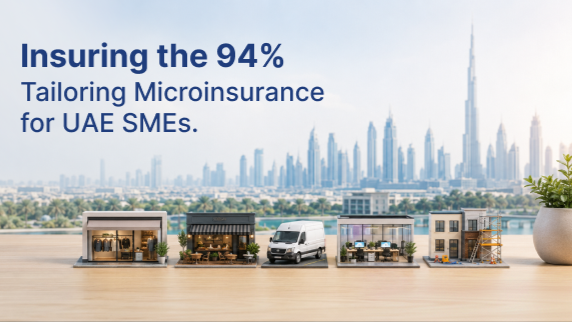
Insuring the 94%: Tailoring Microinsurance for UAE SMEs
Our industry keeps fighting over the same small handful of giants, while the businesses that actually run this economy go largely unprotected.
Small and medium-sized enterprises now account for more than 94 percent of businesses in the UAE and generate over 60 percent of non-oil GDP. These businesses are the operational backbone of the economy, spanning manufacturing, logistics, retail, technology, and professional services. Capital and policy are already backing them, including a one billion AED MSME financing program from the Emirates Development Bank and RAKBANK. The country is pushing toward one million SMEs by 2030, and one gap keeps getting harder to look past. Our insurance products have not kept pace with how much this economy has been redesigned around these businesses.
I have spent my career on the commercial and reinsurance side of this business, and I will say this plainly. Our industry has spent decades perfecting coverage for large corporations, with risk managers, legal teams, and the reserves to absorb a bad quarter. We have barely bothered to do the same for the small business that just signed its first lease and hired its first few employees.
When Growth Outruns Protection
The UAE has built one of the most enabling environments for entrepreneurship anywhere in the world. Forming a business here is faster, easier, and more digital than it has ever been, yet none of that makes a business resilient.
Modern companies face cybersecurity threats, supply chain bottlenecks, and shifting regulations every day, though small businesses rarely have the staff to handle it all. Reforms like corporate tax and e-invoicing will strengthen the economy over the long run. In the near term, however, they add real cost for any business that is not prepared for them.
A large corporation can absorb that complexity because it has the scale and the systems built for it, while a small business with ten employees lacks both. The same disruption that a multinational barely notices can end a small company outright, and that is not a theoretical risk. It is a financial risk, and it shows up at the worst possible time.
An Insufficient Corporate Mold
SME insurance has long been limited by economics, not by lack of demand. Fragmented risk profiles, thin premium per account, and high servicing costs pulled insurer attention toward large corporate accounts, where the numbers are simpler and the returns more predictable. While that strategy made sense for a long time, it no longer does. SMEs makeup more than 94 percent of businesses in this country. They are not a segment insurers can keep treating as an afterthought. Serving them through frameworks designed for corporate risk creates friction at nearly every step, from how a policy is underwritten to how a claim finally gets paid.
Technology is changing that math now. Automation and digital underwriting are removing the costs that once made this segment too expensive to serve well. That makes it possible to build coverage differently. Instead of a smaller version of a corporate policy, a business could buy only the protection it actually needs, sized to whether it is a logistics company, a clinic, or a small design studio. Get that right, and SME insurance stops being something insurers tolerate and becomes something they want.
Brokers Still Hold the Key
None of this works without brokers, and I say this as someone who has relied on them for most of my career. They remain the main channel through which commercial insurance reaches UAE businesses because they understand a client’s operations in ways no underwriting algorithm ever fully will. Even so, they face the same cost pressure as insurers.
A manual process heavy on paperwork makes a small SME account barely worth the time it takes to service. Integrated platforms and real-time underwriting tools are starting to change that reality. These tools cut much of the manual cost out of placing smaller policies.
Combined with modular products, these platforms allow brokers to take on a higher volume of SME accounts without draining their margins. Consequently, the daily routine of the broker is shifting. Those who adapt can move away from merely pushing paperwork, evolving instead into true risk advisors who spot exposure early and structure coverage that genuinely fits a business.
What Is Really at Stake
The UAE wants sustainable, entrepreneur-led growth, and small businesses are proving they can deliver it. They are launching across nearly every sector at a pace few markets can match. Even so, growth without a safety net is simply speed without brakes. This maturing economy should no longer be judged by how many businesses launch. The real measure is how many can survive a genuinely bad year.
Our industry faces a real choice here, not a hypothetical one. We can keep competing for the same narrowing pool of corporate accounts, or build for the market that already exists. I see this less as an opportunity and more as an obligation. Protecting the businesses that now define this economy is not a side product next to our commercial book. Instead, it is part of what insuring the UAE means today. Whoever in our industry gets there first will earn the trust of the businesses quietly carrying this economy forward, a reward worth far more than any premium.